21.08.2026 · ASROYAL
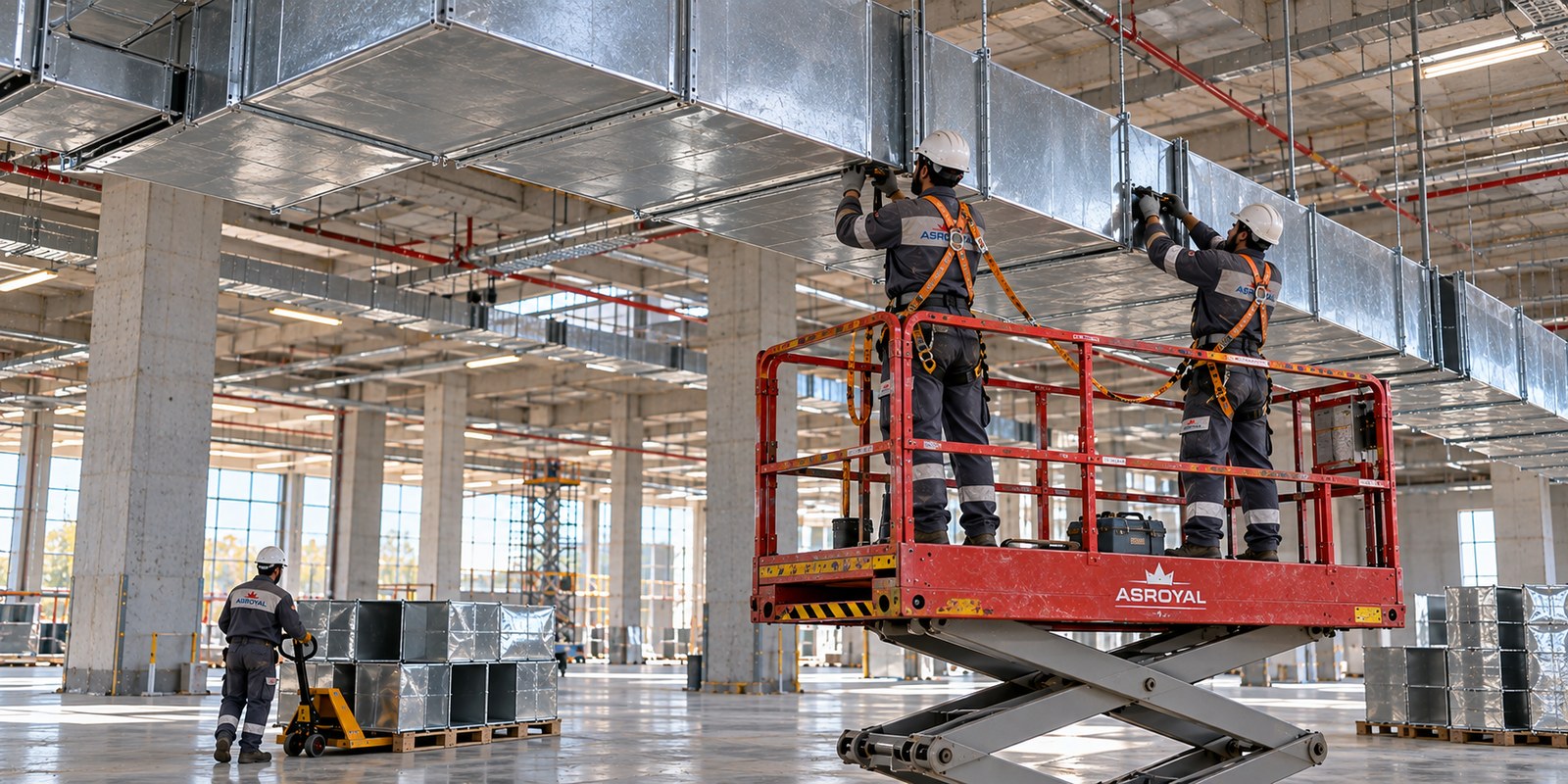
Ventilation in an industrial plant is not solved by opening a window. Heat, vapor, dust and gas from the process are calculated together with fresh air, exhaust points and filtration. ASROYAL treats that calculation as part of the mechanical project, drawing on work carried out since 2001.
Fresh air and exhaust are planned together
Ventilation systems do not only supply air. If exhaust is weak, fresh air cannot move through the room. On cooking lines, hood ventilation captures grease and vapor at the source. In a production hall, supply and exhaust are balanced so doors are not turned into unintended intakes.
Dust and explosive atmospheres
Wood dust, flour, weld fume or chemical dust should not stay in the open hall. Dust collection pulls from a point near the source, filters and discharges under control. Where solvents, paint or flammable gas are present, the fan, motor and duct selection changes. Those lines are designed separately as explosion-proof ventilation.
The sector changes the plan
In production plants the process load leads. In healthcare buildings airflow direction, filter stages and room pressure lead. The same fan does not serve both. Airflow is not chosen before machine layout, shifts and exhaust points are clear. Use the contact page to discuss a project.