Mechanical Installation Systems for Food Production Facilities
Food factories, dairy plants, meat and processed-food facilities, bakeries, beverage factories, cold-chain centers and packaging plants are industrial facilities where hygiene, temperature control, process continuity and product safety must be maintained together. Mechanical systems in these facilities are critical not only for employee comfort but also for preserving product quality, reducing cross-contamination, maintaining appropriate pressure relationships and ensuring reliable production processes.
ASROYAL provides solutions for the design, equipment selection, installation and commissioning of hygienic ventilation, process air, compressed air, steam, hot and chilled water, process cooling, cold rooms, fire protection and building automation systems for food production facilities.
Hygienic Ventilation Systems
Ventilation is a fundamental component of product safety in food production areas. In production, filling, packaging and high-hygiene zones, air should be managed not only for temperature and humidity but also to help limit the transfer of particles, odors, aerosols and microorganisms.
Hygienic air handling units may incorporate cleanable internal surfaces, appropriate drainage, accessible maintenance sections, airtight casing and multi-stage filtration according to process requirements. Pre-filters, fine filters and, where required, HEPA filtration can be applied. Fresh-air and exhaust quantities are determined according to heat and moisture loads and contaminants generated by the process.
Positive or negative pressure zones can be designed to establish controlled airflow between clean and less-clean areas. This helps reduce unwanted air transfer between raw-material, cooked-product, packaging and waste zones. Condensation prevention, sufficient fresh air and cleanable equipment are key elements of hygienic design.
Importance of Ventilation in Food Production
Insufficient ventilation in food plants may contribute to excessive humidity, surface condensation, odor accumulation, mold growth and transfer of contaminants between production zones. Heat and moisture generated by cooking, washing, steam processes, drying and rapid cooling should therefore be removed in a controlled manner.
A properly designed ventilation system helps protect areas where food is exposed, provides suitable working conditions for personnel and supports stable process temperatures. Ventilation design should be evaluated together with the facility's HACCP approach and hygiene zoning.
Process Air and Compressed Air Systems
Air installations in food production may include process air and compressed-air systems in addition to general ventilation. Pneumatic equipment, filling and packaging machines, automation components and certain production processes use compressed air.
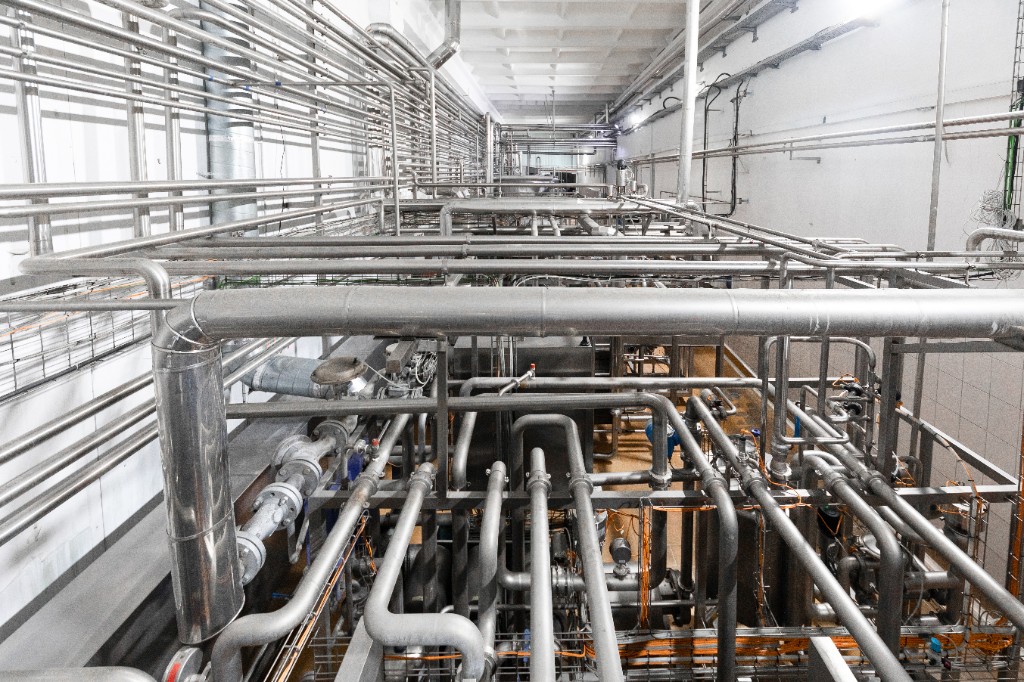
Compressors, air dryers, filters, receivers and distribution piping are the principal components. Where compressed air comes into direct or indirect contact with food, air quality requires particular attention; oil, water, particles and microbiological risks should be controlled according to process requirements.
Pipe diameters should be selected according to required airflow, operating pressure, simultaneous demand and acceptable pressure drop. Ring-main systems can improve pressure balance and operating continuity in large facilities.
Steam Systems
Steam is widely used in food production for cooking, pasteurization, sterilization, CIP cleaning and heating of tanks and process equipment. A steam system may include boilers, steam headers, main distribution lines, pressure-reducing stations, separators, steam traps and condensate-return systems.
Pipe sizes should be selected according to steam flow, pressure, allowable velocity and pressure drop. Correct pipe gradients, condensate drainage and insulation are important for both safety and energy efficiency.
Where steam comes into direct contact with food, steam quality should be assessed separately. Recovering condensate wherever practical can reduce feed-water and fuel consumption.
Cooling and Cold-Chain Systems
Cooling is a fundamental element of food safety from raw-material receiving through production, process cooling, blast chilling/freezing, storage and dispatch. Depending on the facility, chiller systems, glycol-water circuits, direct-expansion systems, centralized refrigeration and cold-room applications may be used.
Temperatures for cold rooms, frozen stores, rapid-cooling tunnels and process equipment should be determined according to production requirements. Compressors, condensers, evaporators, pumps, heat exchangers and control systems should be selected with energy efficiency and operational continuity in mind.
Critical temperatures can be monitored and recorded through automation, with alarms generated when limits are exceeded. This supports continuity of the cold chain.
Post-Production Quality Control and Laboratory Areas
Quality-control laboratories are an important part of food-production infrastructure, enabling physical, chemical and microbiological checks on raw materials, process samples and finished products. Laboratory scope should be defined according to the product group and the analyses to be performed.
Microbiology, sample preparation, chemical analysis and instrument rooms should be separated where necessary, with appropriate temperature, humidity, fresh-air supply and pressure relationships. Laboratory exhaust systems, fume hoods, local extraction, filtration and safe discharge arrangements should be designed according to the nature of the analyses.
Laboratories may also require purified water, hot and cold water, drainage, technical gases, compressed air, uninterrupted power and automation infrastructure. In microbiological areas, cleanable surfaces, controlled airflow and prevention of cross-contamination are important design criteria.
Hot/Cold Water and CIP Systems
Food facilities may consume large quantities of process water, domestic hot water and cleaning water. Water storage, booster systems, filtration, softening and other process-specific water-treatment systems should be designed according to facility requirements.
CIP (Clean-in-Place) systems allow tanks, pipelines and process equipment to be cleaned in a controlled manner without dismantling. Control of temperature, flow, chemical concentration and cycle duration is important for hygienic performance. Where appropriate, recovery of CIP return water and heat can reduce water and energy consumption.
Fire Safety and Building Automation
Fire-protection systems in food plants should be designed according to production areas, warehouses, technical rooms, electrical rooms and process risks. Sprinklers, fire hose cabinets, hydrants, fire pumps and suitable special extinguishing systems are evaluated according to the facility's hazard classification.
Building and process automation can centrally monitor air handling units, refrigeration systems, pumps, fans, boilers, compressors, temperature and humidity sensors and energy meters. Critical temperature, pressure and fault data can be recorded and alarmed to maintenance and production teams.
Energy Efficiency and Heat Recovery
Because food-production facilities may consume heating, cooling, steam and compressed air simultaneously, they offer significant opportunities for energy recovery. Compressor waste heat, refrigeration condenser heat, hot process streams and suitable exhaust-air sources can be used for domestic/process hot-water preheating or other appropriate processes.
Variable-speed pumps and fans, high-efficiency motors, correct pipe and duct sizing, automation strategies and energy metering help reduce operating costs.
ASROYAL
ASROYAL provides design and installation solutions for hygienic ventilation, process and compressed air, steam, heating, cooling, cold rooms, plumbing, fire protection, laboratory mechanical infrastructure and building automation systems for food factories and production facilities.
In addition to new investments, we carry out capacity upgrades, mechanical-system renovations, energy-efficiency improvements and modernization of process infrastructure in existing production facilities.